Die Casting Tooling: What Drives Cost and Die Life
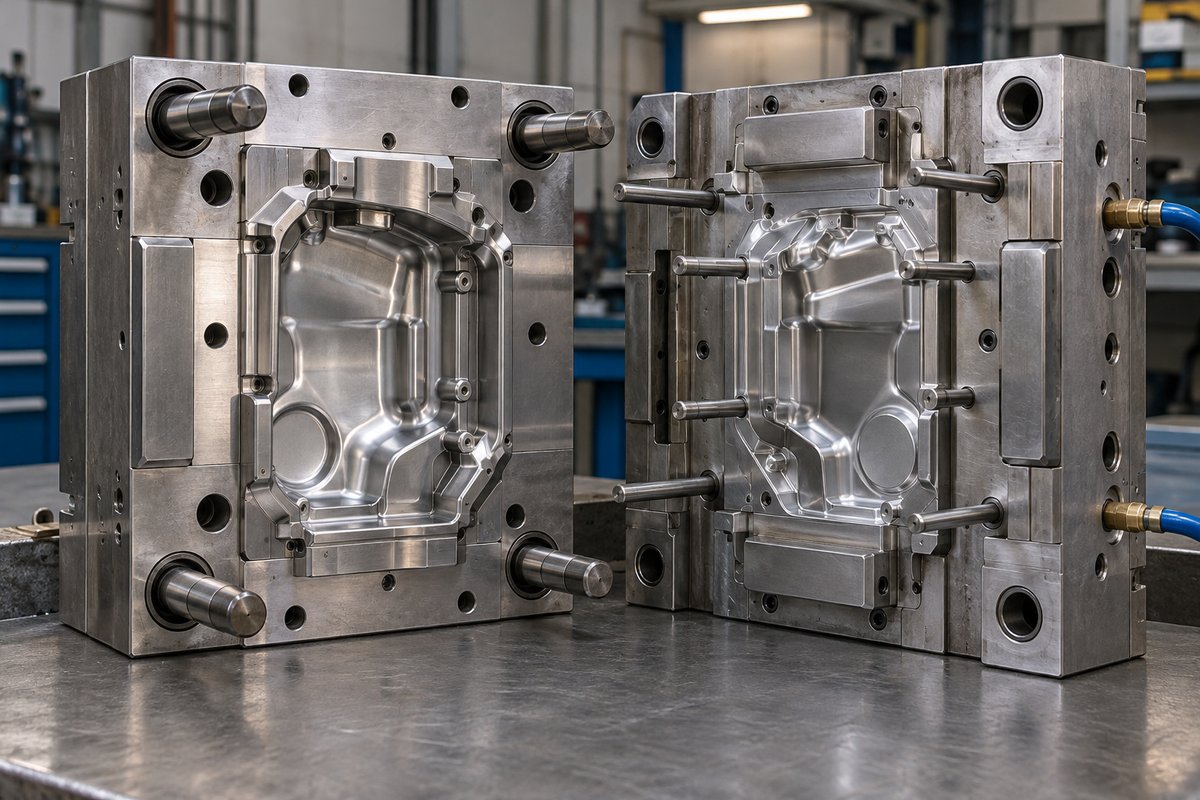
A die casting die is a hardened steel tool that contains the molten metal under pressure and gives the part its shape. It has a cover half and an ejector half, the cavity, runners and gates, overflows and vents, cooling channels and ejector pins.
What drives tooling cost
| Factor | Effect on cost |
|---|---|
| Part size | Bigger parts need bigger dies and bigger machines |
| Number of cavities | More cavities lower piece price but raise tooling cost |
| Slides (side actions) | Side holes and undercuts need slides, adding cost |
| Complexity | Deep ribs, thin cores and complex surfaces add machining and maintenance |
| Tool steel and heat treatment | Hot-work steels such as H13 are typical; the specification affects cost |
| Accuracy and cosmetic demands | Polished cosmetic surfaces and tight features add work |
Tooling cost and piece price trade off. High annual volumes justify more cavities and a lower piece price; low volumes favor a simpler die and lower up-front cost.
Die life
Dies see repeated thermal expansion and contraction, which causes fine surface cracking (heat checking) that eventually affects surface finish and dimensions. Life depends on the alloy, geometry, process conditions and maintenance.
- Zinc dies usually last longer than aluminum dies because casting temperatures are lower.
- Planned maintenance and insert replacement are normal ways to extend life.
- Agree expected life and who pays for refurbishment or replacement when you order.
Terms to agree before ordering
| Item | What to agree |
|---|---|
| Ownership | Who owns the die once paid for; storage and return conditions |
| Storage and identification | Where the die is kept, marking, and what happens if it is idle for a long time |
| Maintenance | Routine maintenance versus end-of-life replacement costs |
| Design changes | Whether and how the die can be modified, and at what cost |
| First article approval | Measurement scope, cosmetic samples and sign-off steps |
FAQ
How much does a die casting die cost?
There is no standard figure; it varies widely with part size, cavities, slides and complexity. Send the drawing and annual volume and we will quote tooling and piece price separately.
Can I move the die to another supplier later?
Ownership and transfer terms are agreed at order. Dies are designed for a specific machine size and setup, so the receiving supplier's equipment must be checked.